Early dementia + family

Capture the stories while they're still yours.
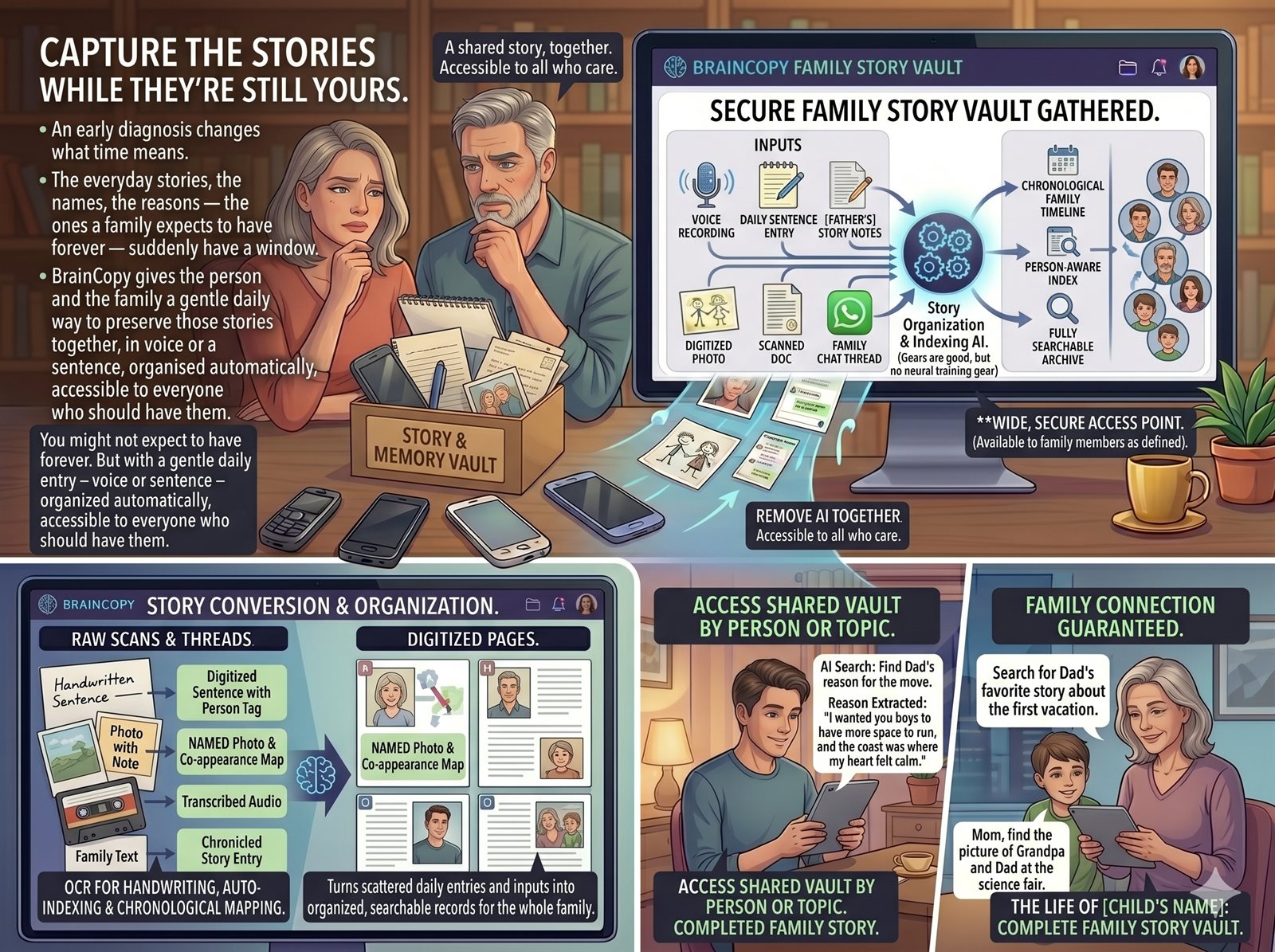
Family capturing stories and organising memories while capacity is still there, shared secure family vault

An early diagnosis changes what time means. The everyday stories, the names, the reasons — the ones a family expects to have forever — suddenly have a window. BrainCopy gives the person and the family a gentle daily way to preserve those stories together, in voice or a sentence, organised automatically, accessible to everyone who should have them.

The problem

You know there's a window. You don't know how long. The stories behind the photos — who this is, where that was taken, why this mattered — are the family's inheritance, and right now only one person holds them.

The obvious solutions are overwhelming. "Record everything" is not a plan. "Write a memoir" is a sixty-hour commitment nobody has. Meanwhile the afternoons drift by, and the window narrows.

And when things get harder, a shared archive suddenly becomes essential — not just for legacy, but for now: the carer needs context, the other siblings need to know what's been captured, the person themselves benefits from returning to their own stories.

How BrainCopy solves it

Import the photo archive first — the stories follow

Upload Facebook, Google Photos, iCloud, scanned albums. BrainCopy organises them by year, place and person automatically. The photos themselves become prompts: "Tell me about this one" is far easier than "tell me your life story."

Voice capture, turned into text

Tap, talk for a minute, done. BrainCopy transcribes, files by date, and links to the relevant photo or person. Over weeks, this builds a corpus of stories and reflections in the person's own voice and phrasing.

Daily digest — the gentle prompt

Each morning, BrainCopy can ask one gentle question based on the archive — "who was at the Midsummer in this 1978 photo?" — that takes thirty seconds to answer. Compounds over a year into thousands of preserved memories.

A shared family view

Siblings, a spouse, a carer — each can be given appropriate access. Not a chat group, not a Dropbox — a structured archive where "who is this in the 1962 photo" has an answer everyone can find, not just the person whose memory is fading.

Preserved in a form that keeps working

Later, when things are harder, the archive becomes a navigational aid: "that's your grandson Lars, he visited last week." Earlier stories, in the person's own voice, can be replayed. Photos with names reduce confusion. The value keeps compounding.

What you'll actually see

Beta price for Early dementia + family

50% off the €10/month subscription, forever. Take it gently — this is not a race.

FAMILY50

Start with FAMILY50 See full pricing

FAQ

Isn't this too much for someone already overwhelmed?
That's why BrainCopy is designed around sentence-or-voice capture. Nobody is asked to write a memoir. The family can do the import and organising; the person contributes stories at their own pace. The threshold is "point at a photo, say a sentence."
What about dignity and consent?
This is important. BrainCopy is the person's archive, not the family's. Ideally the person opts in while capacity is full. A power of attorney or designated access can continue the work later — but the goal is to preserve their voice, not to surveil them.
How does the family share access?
Legacy recipient roles with per-tag scope. A spouse might have full access; adult children might have "everything about family history but not medical" access; a carer might have "just the daily-context stories" access. Granular and revocable.
What if the person's ability to use an app declines?
The family can continue capturing on their behalf — transcribing from conversations, uploading photos, organising. The archive doesn't require the person to operate it forever; the earlier contribution is the core, and the family keeps adding context.
Cost?
€10/month (€5/month forever with FAMILY50). AI processing for a lifetime of photos is typically €50–€300 one-time. A legacy-preservation plan keeps the archive alive without subscription after — pricing TBD, likely €50–€400.
Can this be used by a care facility?
Currently BrainCopy is a personal/family tool, not a clinical one. A carer can be given access as a family proxy. A formal care-facility product (multi-resident, clinical integration) is not on the roadmap yet.
Is it safe for private stories?
EU-hosted, encrypted, under family control, explicit access per recipient. Nothing is shared without your action.

Ready to try it?

Takes about 30 seconds to sign up. You can start importing immediately.

Start carefully

Who else uses BrainCopy

Different people, same problem: too many memories scattered across too many places.