With limited time

The letters you don't have time to write.
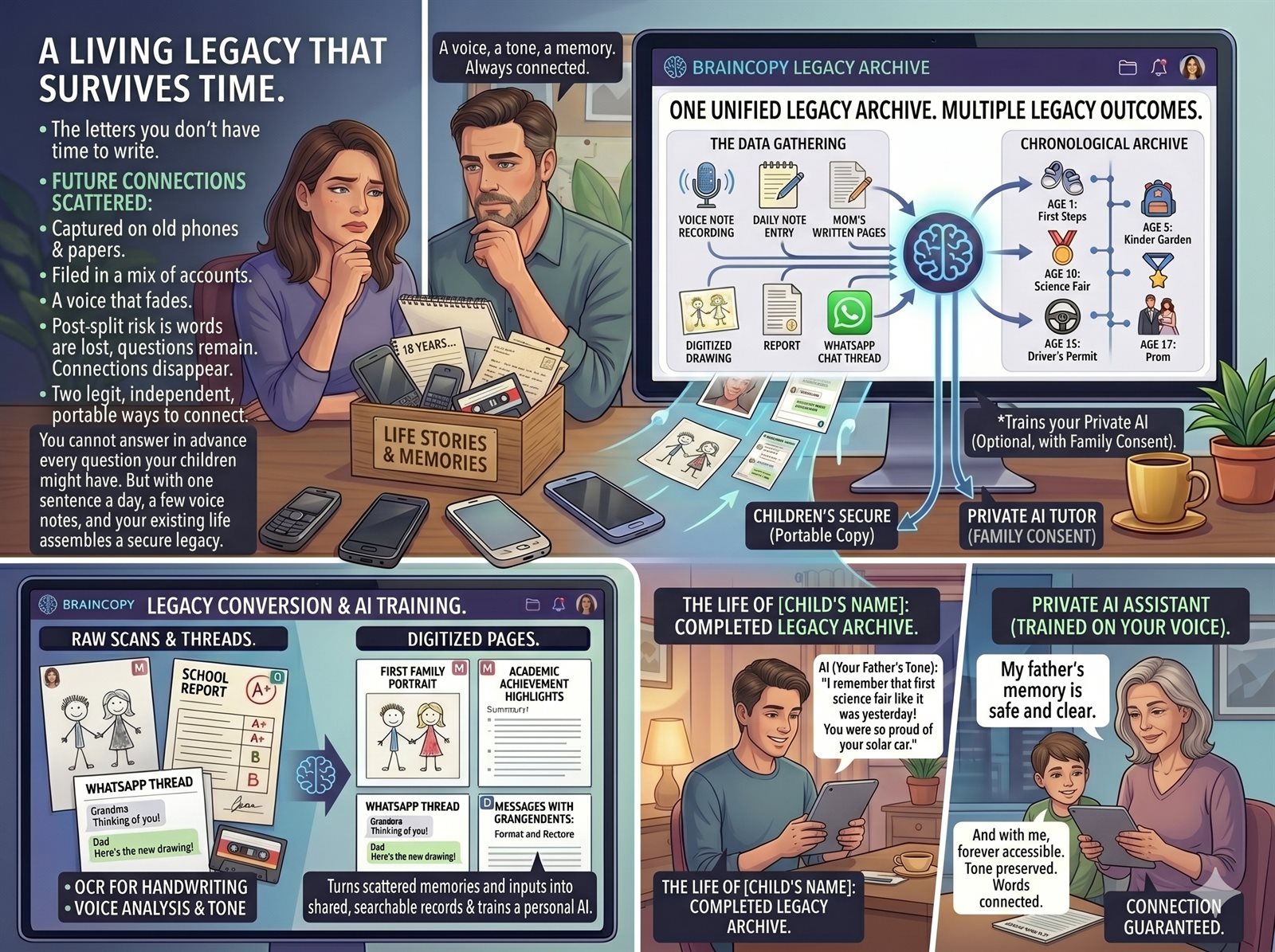
A living legacy archive that survives time: letters, recordings and memories captured and organised for loved ones

You cannot write every letter you'd want to leave. You cannot answer in advance every question your children might have. But with one sentence a day, a few voice notes, and whatever you already have in photos and writing, BrainCopy assembles an archive — and, only if your family wants it, a private AI trained on your own words that can still answer questions in your voice.

The problem

You want to leave something your children and grandchildren can hold on to. A handwritten letter each. A memoir. A recorded answer to the question they haven't thought to ask yet. But the energy and time for that — you don't have it, not in the way it would need.

The old advice — "write a letter to each child for their 18th birthday, their wedding, the birth of their first child" — is beautiful and impossible. You would need twenty afternoons you may not have.

Meanwhile, decades of photos, messages, and writing already exist. They are fragments of your voice, but scattered across platforms, none of them assembled into anything your family can actually receive.

How BrainCopy solves it

Start with what already exists

Import your Facebook, Google Photos, old emails, a scanned journal or two. BrainCopy organises the decade of writing, voice and image you've already produced. Much of your voice is already there.

One sentence a day, one voice note when you can

The threshold is low on purpose. Speak a two-minute story about your childhood. Tell the app something you want your grandchild to know. Write one sentence about today. BrainCopy files each fragment into the right place.

AI drafts chapters in your voice

BrainCopy turns your fragments and your imported history into draft memoir chapters written in your own voice and phrasing. You edit what's wrong, approve what's right, skip what doesn't matter. A handful of edits turns into a book.

Per-person messages

Record short messages for specific people at specific occasions — birthdays, weddings, the 18th — and schedule them to be delivered by a trusted person or by the system. Even three of these, released over twenty years, can be the whole point.

Optional: an AI trained on your words, for when you're gone

For families who want it, BrainCopy can create a private AI ("Chat with Mum") trained on everything you've captured — your writing style, your phrases, your stories. Grandchildren who didn't get to ask can ask. You and your family decide together whether this is wanted, and it can be turned off at any time.

What you'll actually see

Beta price for With limited time

50% off the €10/month subscription, forever. No rush on any of this. We're here to be useful, not urgent.

LEGACY50

Start with LEGACY50 See full pricing

FAQ

Is this too morbid to start?
Many people find the opposite — that the archive becomes something they use while alive, not only a legacy. It turns into shared reading with family, a memoir project that brings conversations into the room, a way to tell the stories now. The legacy side is a byproduct, not the foreground.
What about the AI clone? Is that weird?
It can be, and it's opt-in by the family as much as by you. Some families find "Chat with Mum" extraordinarily comforting — others never turn it on. You don't have to decide now. The archive is valuable either way.
What does it cost my family after I'm gone?
You can prepay a legacy-preservation plan (pricing TBD, likely €50–€400 depending on duration) so the account stays alive without anyone having to pay after you're gone. The printed memoir and voice messages are standalone artefacts that never require any subscription.
What if I only have a few weeks?
Then focus on three things: (1) import what's already digital, no effort needed, (2) record 10 voice notes about moments you want preserved, (3) name a legacy recipient. Even that much produces something irreplaceable.
Who do I trust with this?
You name specific people as legacy recipients, with confirmation periods (default 90 days inactivity + 7 days' notice) before access activates, or you can trigger it manually. You can also assign a secondary verifier for extra caution.
Is this GDPR / compliant?
Yes — EU hosting, Swedish company, full data export and deletion, explicit legacy controls. Your archive is private until you or a designated recipient activates access.
Can my family print the book after I'm gone?
Yes. Designated recipients can continue the memoir/photobook generation work, or simply export and print what you've already produced.

Ready to try it?

Takes about 30 seconds to sign up. You can start importing immediately.

Start carefully

Who else uses BrainCopy

Different people, same problem: too many memories scattered across too many places.