Adopted adults

Who are the people in mom's old box of photos?
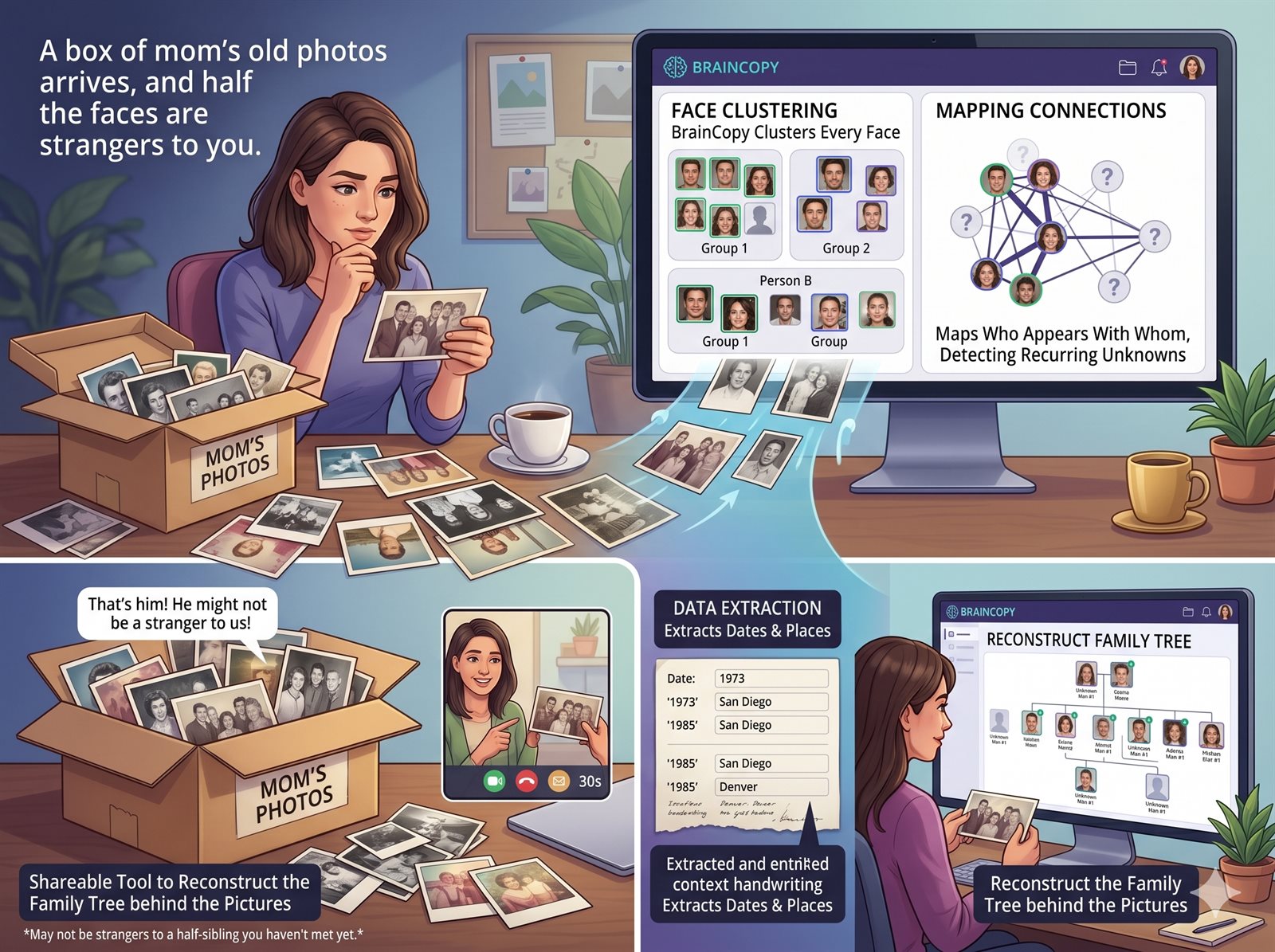
Adopted adult studying inherited family photos with face-clustering and family-tree reconstruction tools

A box of photos arrives, and half the faces are strangers to you — but may not be strangers to a half-sibling you haven't met yet. BrainCopy clusters every face, maps who appears with whom, extracts dates and places, and gives you a searchable, shareable tool to reconstruct the family tree behind the pictures.

The problem

You've done the DNA test. You've found a half-sibling. You've been handed a box. And now every photo is a question: who is this? Where was this taken? What year? Whose wedding? The people who could answer are gone, or unreachable, or reluctant.

The obvious tools don't help. Google Photos groups faces by identity but won't tell you who anyone is. Ancestry has records but no faces. Family members have memories but no time. You have a thousand photos and a dozen questions per photo.

And you can't share the archive easily. Every time a cousin-you've-just-met might recognise someone, you're emailing JPEGs with captions — and losing track of what was already asked, who answered, what's still unknown.

How BrainCopy solves it

Upload the whole box

Photograph each picture (or scan them). Upload the batch. BrainCopy handles thousands of images, extracts dates from photo backs via OCR where written, and auto-corrects orientation.

Face clustering groups the same person across years

AWS Rekognition (used with strict data-retention settings) clusters faces so every photo of "Unknown Woman A" is grouped, from 1952 childhood to 1998 old age. Name the cluster once and every photo of her across the archive is labelled.

AI Vision extracts clues you might miss

Claude Vision reads the context — a military uniform's insignia, a storefront in the background, a graduation gown's colour — and drafts a caption for each photo. These clues narrow down years, places, and events you didn't know were there.

Share individual photos or clusters with family

Tag a face as "identified by aunt Kerstin, Dec 2026." Send a specific cluster to a half-sibling for naming. Track who's been asked, who answered, what's still unknown. Every identification is logged with a date and a source.

A living family tree that updates as you learn

As faces get names and relationships get confirmed, BrainCopy builds a people graph — who appears with whom, at what ages, in what places. Over months, the pattern of the family behind the box emerges.

What you'll actually see

Beta price for Adopted adults

50% off the €10/month subscription, forever, for adopted adults reconstructing a family archive. Your discount never expires.

ADOPTED50

Start with ADOPTED50 See full pricing

FAQ

What about faces the DNA test didn't explain?
Those are the ones BrainCopy is best at. Clustering + photo clues + family-tree inference often identifies a face long before DNA does. And you can share a specific cluster with a newly-found relative to accelerate the identification.
Is face clustering ethical / GDPR-safe?
Face clustering happens in your private archive; results are not shared, sold or used to train models. For EU residents, processing is via AWS eu-central-1 (Frankfurt) with zero-retention. You can disable face clustering and still use BrainCopy as a chronological archive.
What if someone asks me to remove their face?
One-click per-cluster deletion — removes the face data and unlinks it from photos. The photo itself stays, but the identification is gone.
Can I collaborate with a biological sibling?
Yes — per-tag legacy recipients / shared tags. You can share specific clusters with them without sharing your whole archive. The full multi-user workspace is on the roadmap.
Cost?
€10/month (€5/month forever with ADOPTED50). Face detection + vision on a 1,000-photo box is typically €30–€80 one-time. Much cheaper than a genealogist, and you keep the tool afterwards.
What about DNA testing services integration?
Not yet — BrainCopy handles the photo + narrative side of the archive. Many adopted adults use Ancestry/23andMe for the DNA side and BrainCopy for the image/story side. The two are complementary.
I'm worried about finding something upsetting.
That's a real thing with this kind of work. BrainCopy doesn't surface anything you don't look at yourself. You set the pace. Take breaks. The archive is always there when you're ready.

Ready to try it?

Takes about 30 seconds to sign up. You can start importing immediately.

Start your search

Who else uses BrainCopy

Different people, same problem: too many memories scattered across too many places.