AI power users

Your AI has no memory of you. Give it one.
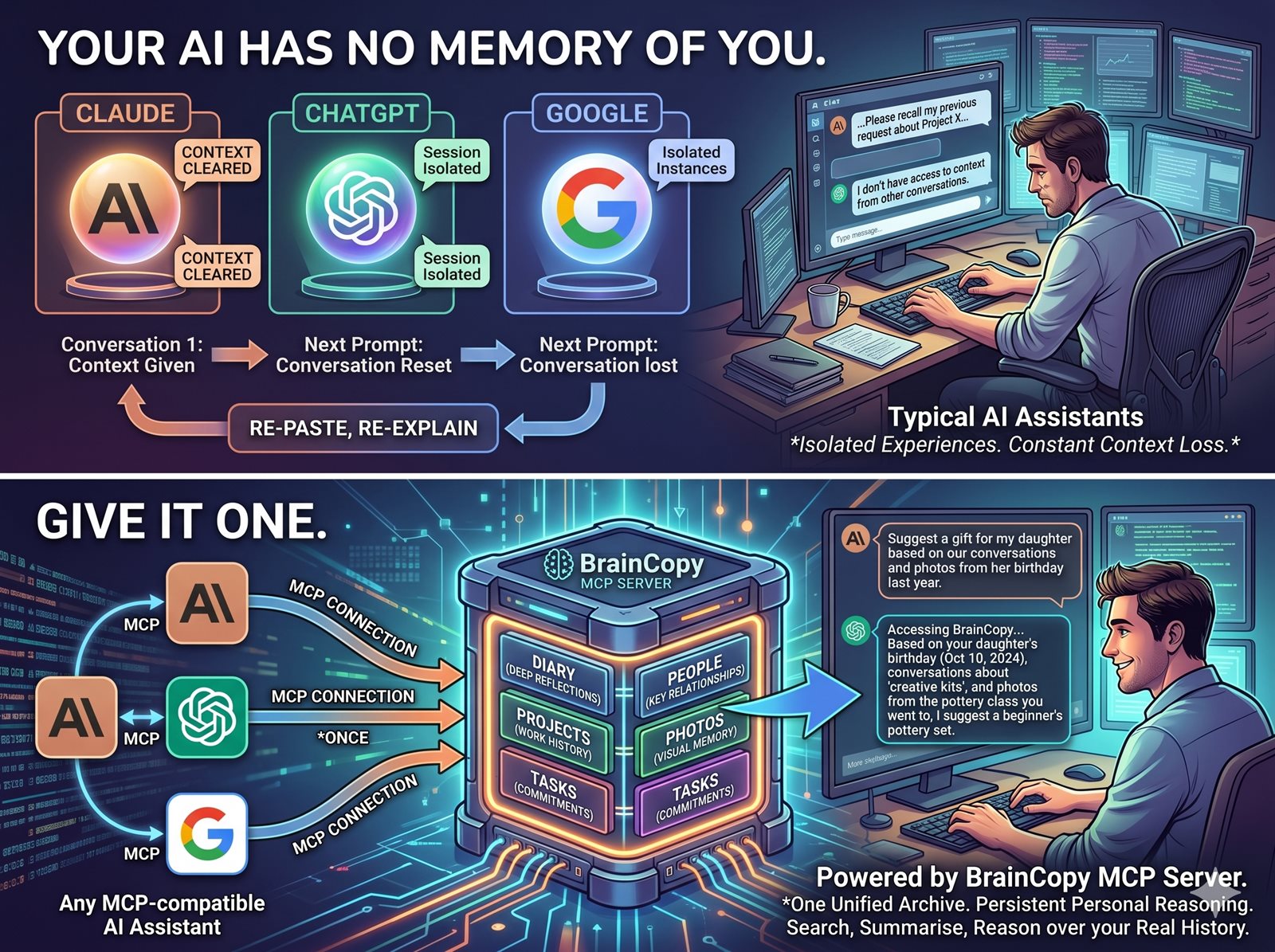
Side-by-side: a typical AI assistant with no memory vs a BrainCopy MCP-connected assistant that retains full personal context

Claude, ChatGPT and every AI assistant you use resets every conversation. BrainCopy is an MCP server (Model Context Protocol — an open standard by Anthropic that lets AI assistants read data from external systems you control) backed by a structured archive of your actual life: diary, people, projects, photos, tasks. Connect once, and any MCP-compatible assistant can search, summarise and reason over your real history — not whatever you paste into the prompt that day.

The problem

Every serious AI workflow hits the same wall: the model has no memory of you. You paste the same context into every conversation. You try prompt-engineering tricks. You build custom GPTs or projects. You dabble with vector DBs. None of it actually solves the underlying problem: your life — people, decisions, history, notes — lives in a dozen places (Google Photos, Facebook, WhatsApp, Notion, Apple Notes, handwritten journals), and none of them have an MCP endpoint.

Building your own memory layer is a project. Ingesting your own data is a project. Writing an MCP server is a project. Keeping it up to date is a project. You wanted to use AI to save time, not to build infrastructure.

Meanwhile the models keep getting better, and the bottleneck is increasingly not the model — it's that the model doesn't know anything specific about you.

How BrainCopy solves it

BrainCopy is an MCP server

Sign up, ingest your data (social-media exports, photos, handwritten notes, capture new stuff via iOS/web/voice), generate a personal API key, and connect it to Claude Desktop, Claude Code, any MCP-compatible client, or your own agent. Eight tools are exposed today: search_diary, search_people, search_media, get_tasks, get_daily_digest, search_memories, capture, complete_task.

All the ingestion is already done

You don't have to write importers for Facebook, Instagram, WhatsApp, Messenger, Google Photos, iCloud, Evernote, handwritten notes, logbooks. BrainCopy has them. De-duplication by content hash across all sources. EXIF extraction via exiftool. Face recognition via AWS Rekognition. AI Vision descriptions via Claude. Handwriting OCR via Claude Vision. Timeline, people graph, location clustering — built.

Capture layer that feeds the memory

iOS + web + voice + Telegram bot capture endpoints. One sentence in, AI classification extracts people/projects/tasks/diary automatically — with user context (your existing people, projects, open tasks) passed into the classifier prompt so it matches existing entities instead of creating duplicates. All captures become part of the MCP-accessible archive.

Structured data where it matters, embeddings where it helps

People are first-class entities with relationships. Projects and tasks are structured. Diary entries are per-day, tagged, linked to media. Search is SQL + full-text today; semantic search via embeddings is on the roadmap. Structured-first means your AI gets clean facts, not fuzzy chunks.

You own the data

Your files (photos, scans, videos) are in a Nextcloud account on European infrastructure we provision for you — you can take them with you if you leave. Database rows export to JSON. Personal API keys are per-user and revocable. No US cloud in your content pipeline.

Open everything

MCP is an open protocol. BrainCopy's API keys work with any compliant client. Well-known discovery at /.well-known/mcp.json. llms.txt for crawler context. Not a walled garden — a memory layer your AI stack plugs into.

What you'll actually see

Beta price for AI power users

50% off the €10/month subscription, forever, for MCP beta users. Your discount never expires.

MCPBETA50

Start with MCPBETA50 See full pricing

FAQ

What is MCP?
MCP (Model Context Protocol) is an open standard from Anthropic that lets AI assistants securely read data from external systems you control. Claude Desktop, Claude Code and a growing list of clients support it. Unlike plugins or custom GPTs, MCP servers are portable — one memory layer, many AI clients.
How do I connect BrainCopy to Claude Desktop?
Go to Settings in your BrainCopy account, generate a personal API key, and paste the connection snippet into Claude Desktop's MCP config. Full instructions are in the Settings UI. Connection is streamable HTTP (JSON-RPC 2.0 over HTTPS) with bearer-token auth.
What tools does the MCP server expose?
Currently eight: search_diary (date-range and text search), search_people, search_media (photos and documents by filter), get_tasks (open and completed), get_daily_digest, search_memories (general cross-collection search), capture (classify and file a new capture), complete_task. More coming — send feature requests.
Does BrainCopy call out to any third-party AI?
For AI processing (face recognition, photo descriptions, diary enrichment, OCR) we use AWS Rekognition (eu-central-1) and Anthropic Claude. These are opt-in, per-use, priced transparently. Your raw content passes through those services for processing but is not stored with them. MCP requests from your own AI clients are served directly from our EU infrastructure — no third-party AI hop.
Can I use my own embeddings / vector DB / LLM?
Today, the MCP server serves structured queries and keyword/full-text search. If you want to pull BrainCopy data into your own vector DB, use the structured export (JSON). Native semantic search via embeddings is on the roadmap. Local-model support (Ollama etc.) works fine — MCP is client-agnostic.
What does it cost?
Base subscription is €10/month (100 GB EU storage, capture layer, MCP server access, sync client, daily digest, photo and voice capture, transcription). With MCPBETA50: €5/month forever. AI processing (face, vision, OCR, enrichment) is per-use with exact cost calculation from your data — priced so the margin is transparent.
I'm an engineer. Can I self-host?
The iOS app, web app, capture endpoints and importers are open to subscribers. A full self-host option is not currently supported — the value BrainCopy delivers requires the combined stack (storage, workers, ingestion pipelines, AI integrations). If you want to extend or contribute to the open parts, reach out.

Ready to try it?

Takes about 30 seconds to sign up. You can start importing immediately.

Start your developer trial

Who else uses BrainCopy

Different people, same problem: too many memories scattered across too many places.