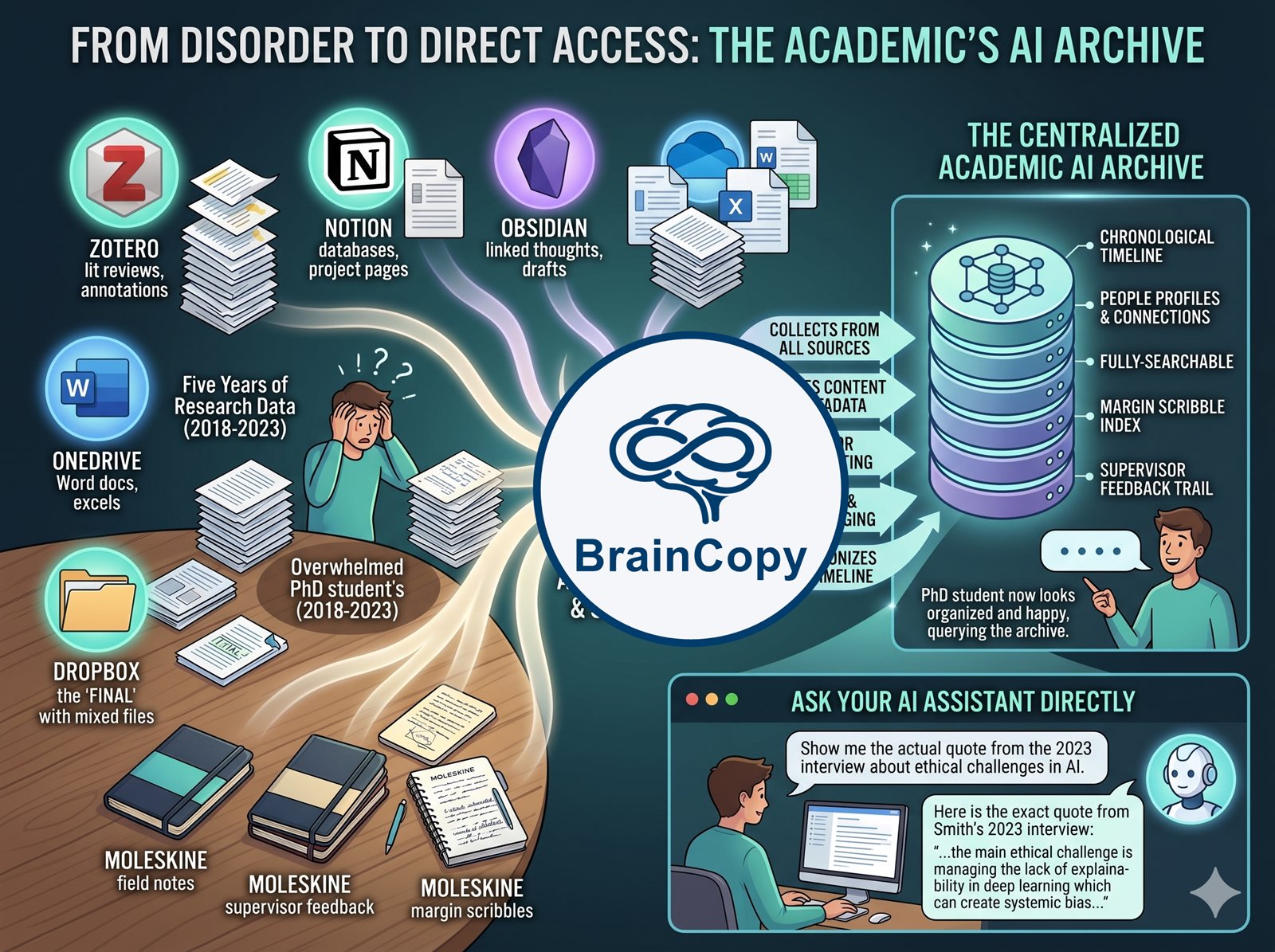
Five years of interview transcripts, field notes, lit review, supervisor feedback and margin scribbles — scattered across Zotero, Notion, Obsidian, OneDrive, a Dropbox folder called "FINAL" and three moleskines. BrainCopy pulls them into one chronological, people-aware, fully-searchable archive that your AI assistant can query directly.
You ran twenty interviews in 2022, took forty pages of field notes in 2023, read three hundred papers across the whole thing, and wrote your thesis chapter in 2025. Your quotes are in one place, your notes in another, the PDFs in Zotero, and the synthesis is in your head — which is the only place you can't search.
Every time your supervisor says "didn't that participant say something like this?" you spend two hours finding the exact passage. Or you don't find it, and you reconstruct it, and you worry slightly that you're mis-quoting someone from an interview you did three years ago.
You tried Notion, Obsidian, Roam, Scrivener, NVivo. They each solve one layer. None of them handles "everything I wrote, heard, and read for five years" as one queryable space — and none of them plugs into Claude or ChatGPT so your AI can actually use your research as context.
Upload Zotero libraries, Obsidian vaults, Notion exports, scanned paper notebooks, interview audio, Word docs, OneDrive folders. BrainCopy handles each format natively — OCRs handwriting, transcribes audio, preserves Zotero metadata.
Interview from 2022 → attached to the participant (anonymised as you wish). Field notes → filed chronologically. Lit review notes → linked to the paper's citation. A five-year research trajectory becomes navigable by date, person, paper, or theme.
Walking home from an interview, record a two-minute reflection. BrainCopy transcribes, files it under the interview, and links it to the participant. Your "how did that really go?" moment is captured while it's fresh, not reconstructed six months later when you sit down to code.
BrainCopy exposes your research archive to Claude or ChatGPT through MCP (Model Context Protocol). "Which participants talked about work-from-home fatigue?" becomes one query. The AI pulls actual quotes with citations, not hallucinations. Your thesis-writing LLM finally has the primary data in front of it.
Participant data is legally loaded. BrainCopy runs on European infrastructure (Germany, Sweden), you hold the encryption, and participant anonymisation is enforced in how data leaves the archive. Your ethics committee will recognise this.
50% off the €10/month subscription, forever, for PhD students and academics. Your discount never expires. For students on a stipend.
ACADEMICS50). One-time AI processing for a multi-year archive is typically €30–€150 depending on size. This is meant to be affordable on a PhD stipend.Takes about 30 seconds to sign up. You can start importing immediately.
Start your academic trialDifferent people, same problem: too many memories scattered across too many places.