Reporters accumulate thousands of sources, transcripts, briefings and background notes across a career. They live on laptops, on paper, in old Evernote accounts, in Signal threads. BrainCopy pulls them into one EU-hosted, encrypted archive your AI assistant can query — without sending a single byte of source material to a US chatbot.
Five years into a beat you have a network of a thousand contacts, a hundred interview transcripts, and a dozen notebooks of margin reporting. Finding a specific quote from 2022 is a two-hour excavation, and you're not the only one who's taken notes — an editor, a producer, maybe a fact-checker each has fragments.
The modern note-taking stack — Notion, Evernote, Google Docs, iCloud Notes — is all on US infrastructure, none of it end-to-end encrypted against the platform itself, and increasingly entangled with AI training that your sources did not consent to. This is not just a GDPR issue; it's an operational security issue.
Your AI assistant would be transformative for reporting — "every source who mentioned X across my archive" — but you can't feed source material to a US chatbot without breaking trust and possibly breaking law, depending on jurisdiction.
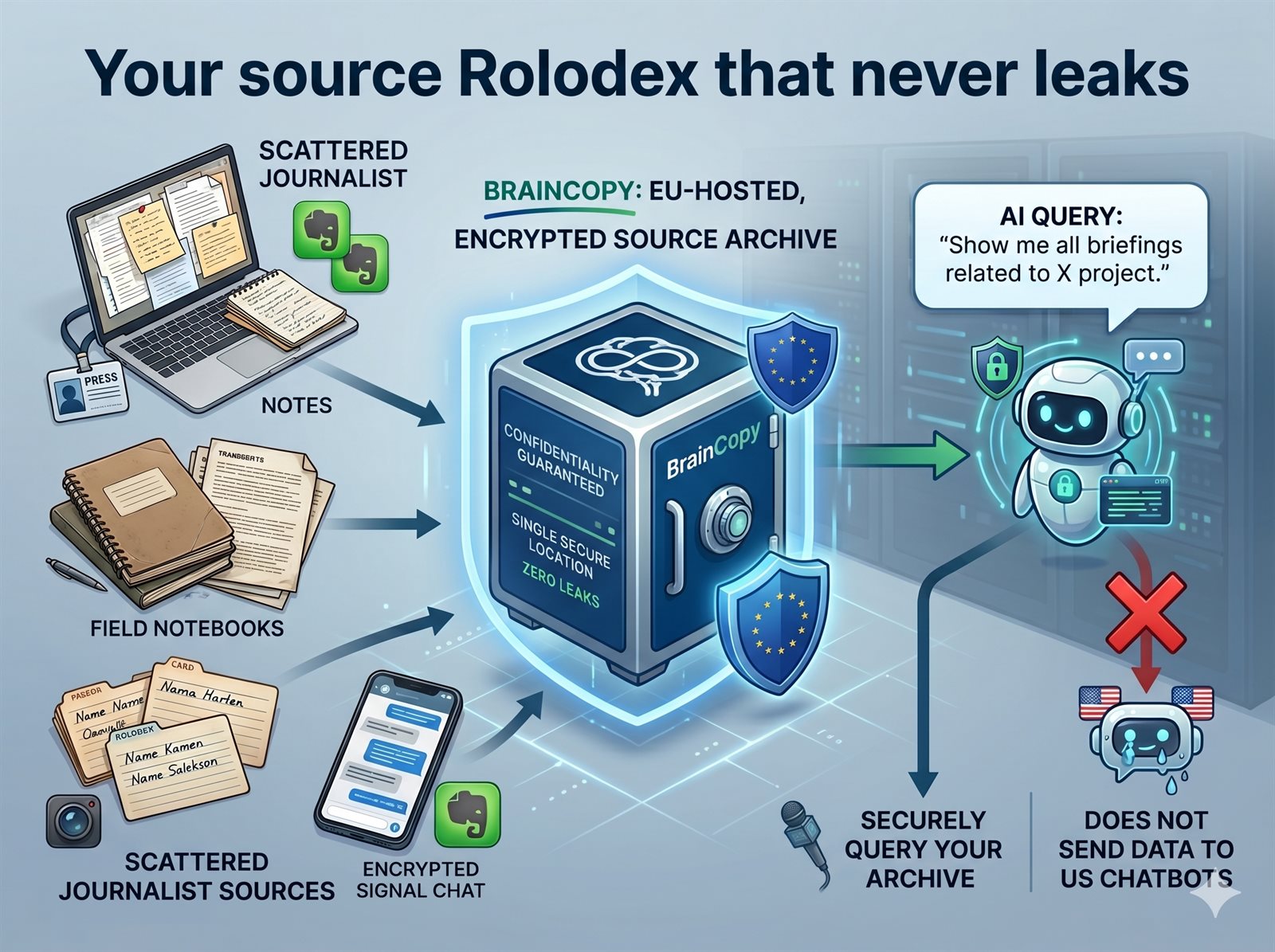
Import Evernote, Notion, Apple Notes, Google Docs exports, Signal archives, old laptop folders. BrainCopy stores them on Hetzner Germany, per-user encrypted, under Swedish-company data governance. One searchable corpus, off US infrastructure.
Each source in your people graph accumulates every mention, every interview, every call log, every document shared. Years of reporting on one person becomes a continuous file, not a search-across-twelve-tools exercise.
Claude-based OCR handles reporter shorthand and the margin-of-a-page kind of writing. Uncertainty is flagged, not guessed — you can cross-check against the recording if you kept one. Decades of paper reporting become full-text searchable.
Claude or ChatGPT connects to your BrainCopy as an MCP tool. "Every source who mentioned a specific shell company across three years" returns a list with citations. The AI queries your archive but doesn't upload wholesale content to the model provider; you can also run entirely local AI if you prefer.
Tag sources as "sensitive" — these are excluded from AI responses by default, from exports by default, and require explicit per-source opt-in for any sharing. Audit log of every access. One-click "scrub this source" for subject access requests or legal risk moments.
50% off the €10/month subscription, forever, for working journalists. Your discount never expires.
PRESS50). One-time OCR + import of a decade of notebooks is typically €100–€400. Expensable as a professional tool in most jurisdictions.Takes about 30 seconds to sign up. You can start importing immediately.
Start your reporter trialDifferent people, same problem: too many memories scattered across too many places.